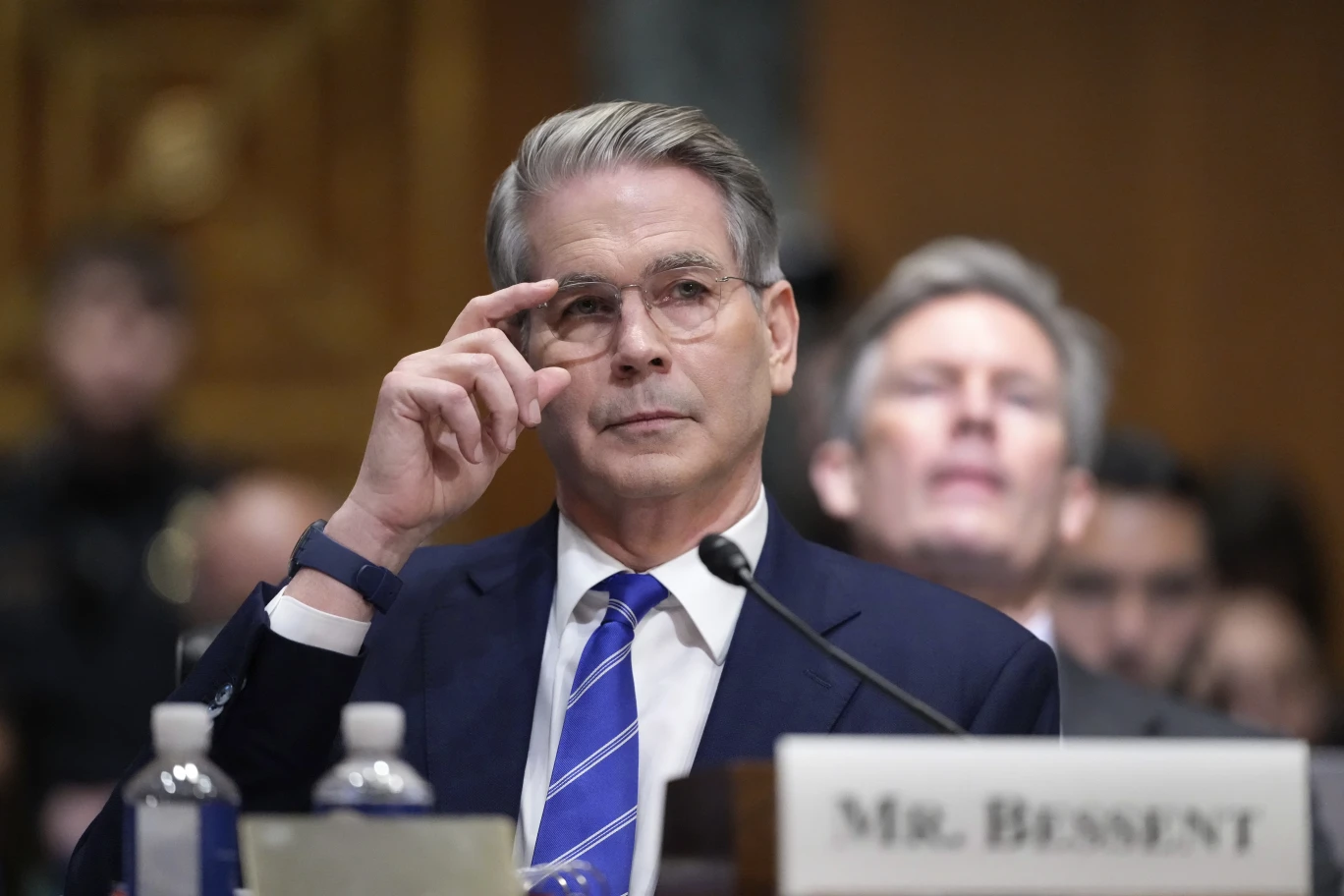
The Treasury Department has seen a dramatic exodus of President Donald Trump’s own appointees, outpacing the turnover of any other recent administration.
Since the start of the second Trump administration, seven of 16 Treasury appointees confirmed by the Senate — or roughly 44% — have either quit or been pushed out of their positions, according to the Partnership for Public Service, a nonpartisan watchdog. That does not account for the turnover in Treasury Secretary Scott Bessent’s office; he has had at least three different chiefs of staff since the beginning of the administration.
At least four of the seven top Treasury officials left after disagreements with the White House over demands to stretch, if not violate, tax law. Those disputes included Treasury resistance to a controversial push to use taxpayer data as part of the administration’s immigration crackdown, as well as the president’s push to establish a $1.8 billion fund to compensate allies as part of a deal with the IRS to drop any past or future tax audits of the president and his family. (The “anti-weaponization” fund was later dropped due to resistance from Senate Republicans.)
“They’re asking them to do stuff that is well beyond the norm, and for some things that may or may not be legal,” said Mark Mazur, who held senior positions at the IRS under both parties and was acting assistant secretary for tax policy in Biden’s Treasury Department. “A lot of these people expect to have a career after this administration, and being disbarred would be a bad thing for them.”
Trending


A spokeswoman for the Treasury Department declined to comment.
Bessent is widely regarded as more competent than most of Trump’s Cabinet, and has bridged the divisions on the right better than many of the president’s aides. His allies on the right credit him with doing more to execute Trump’s agenda than Steven Mnuchin, the president’s first treasury secretary, and also argue his hard-charging Wall Street style is an asset.
An enormous number of responsibilities currently fall under Bessent’s remit, from managing the risks of artificial intelligence to crafting economic sanctions on Iran as part of the U.S. war effort.
“Secretary Bessent is doing a fantastic job delivering the President’s agenda for the American people,” said Nick Solheim, the chief operations officer at American Moment, a pro-Trump advocacy and recruitment organization. “He and many of the appointees at Treasury have made a great sacrifice leaving the private sector to take roles in public service so that we have a financial system that works for every American.”
Still, the level of churn among his senior ranks — far higher than that under any other treasury secretary this century — shows that even Republican tax officials have balked at Trump’s demands on the IRS, which is a part of the Treasury.
The departures also raise questions about whether gaps in the Treasury’s ranks could undermine its response to an economic crisis or other emergency.
By this point in their terms, the Obama and Biden administrations had lost zero Senate-confirmed appointees, according to the Partnership for Public Service. The Bush administration and the first Trump administration had lost two each by this point.
Like many agencies under the second Trump administration, the Treasury and IRS have also lost thousands of career employees up and down its ranks. The number of IRS employees has fallen by about a quarter, and Treasury has lost senior officials including David A. Lebryk, who had served in senior Treasury positions under six administrations, and Andrea Gacki, who served as director of the Financial Crimes Enforcement Network.
But many agencies under Trump have pushed out many of their career officials with far less turnover among the senior political ranks. For instance, the State Department has lost only one Senate-confirmed appointee, the Partnership for Public Service found. The Defense Department has only lost two senior Senate-confirmed officials.
Among those to depart Treasury’s senior ranks were Republicans in good standing with the party. While the exact reasons for their exits are unclear, they came after disagreeing with directives from the White House.
John Hurley, a Trump donor who was appointed undersecretary for terrorism and financial intelligence, left the department after expressing concerns about a White House-led crackdown to target international payments from Minneapolis, though there were other factors at play in his departure. Several legal experts said the Minneapolis order to scrutinize immigrant payments violated constitutional protections against unreasonable search and seizure.
Ken Kies, an assistant treasury secretary and acting IRS chief counsel, was forced out after objecting to a White House request that risked violating an IRS code limiting political interference in audits or taxpayer investigations, according to one person familiar with the matter, who spoke on the condition of anonymity to describe a private conversation. The Wall Street Journal first reported on the circumstances behind his departure.
Billy Long, the Senate-confirmed IRS commissioner, was pushed out after objecting to demands that the IRS give confidential taxpayer information to the Department of Homeland Security.
The IRS had seven different acting commissioners last year: Danny Werfel, Douglas O’Donnell, Melanie Krause, Gary Shapley, Michael Faulkender, Long, and Bessent. Trump has not nominated a new commissioner. Frank J. Bisignano, who is also the commissioner of the Social Security Administration, is currently serving as the “chief executive officer” of the IRS, a new position with no apparent designation in law.
Brian Morrissey, the treasury general counsel, resigned hours after the Trump administration announced its plans for the $1.8 billion fund to make payments to Trump’s political allies.
“People are really concerned about a job that they would normally see as the highlight of their career,” said Nina Olson, the former head of the Taxpayer Advocate, a nonpartisan watchdog group. “What they are being asked to do appears to put them at risk of civil or criminal penalties.”
Tax experts and various former government officials have raised questions about the impact of the turnover. Daniel Bunn, president and CEO of the Tax Foundation, a conservative-leaning think tank, expressed concern that the absences could slow the process of writing the regulations necessary to implement the tax law Republicans approved last year.
“It’s a real risk to the policy legacy of the administration on tax to not have these roles filled with people that can make sure the policies get implemented in line with the legislation,” Bunn said. “Anytime you have gaps in the leadership structure it’s tough.”
Bessent has been more hands-off in drafting regulations than his predecessor Mnuchin, according to two former Treasury officials, who spoke on the condition of anonymity to describe private interactions. With several posts all still open, much of that burden has fallen on a shrinking core of remaining officials.
“I’m an admirer of both Secretary Bessent and IRS Chief [Frank] Bisignano,” said Mark Everson, who ran the IRS during the Bush administration and also served under President Ronald Reagan. “That said, if leadership is stretched too thin it can be harder to keep the trains running on time and difficult to respond effectively in the event a crisis comes along and you need all hands on deck.”
Author
